

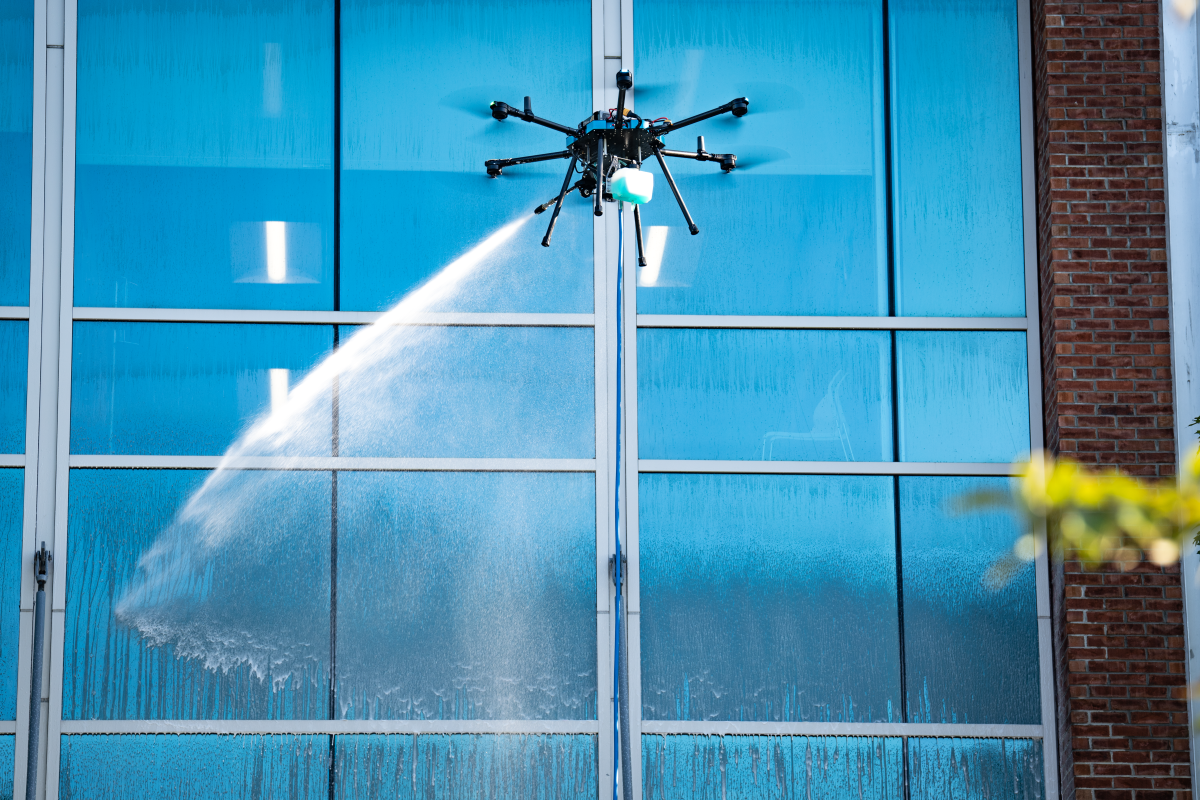
Window washing drones are pulling venture capital away from flashier corners of the robotics world. Lucid Bots, a Charlotte-based startup building robots for building maintenance, just closed a $20 million Series B round [NEW] co-led by Cubit Capital and Idea Fund Partners, bringing total funding to $34 million.
Andrew Ashur, founder and CEO, says his company sits at the opposite end of the robotics hype cycle. While competitors chase humanoid robots and viral acrobatics videos, Lucid Bots builds window washing drones and pressure-cleaning robots for businesses that need practical results on real job sites.
Performance Over Headlines in the Window Washing Drones Market
Ashur makes no apologies for his company’s unglamorous focus. He points out that most robotics startups are still selling concepts from labs and simulations. Lucid Bots, by contrast, operates on active job sites every day.
That approach matters because the drone-based cleaning system market is projected to reach $4.85 billion by 2033 [NEW], growing at roughly 17% annually. North America alone is expected to hold around 41% of market share in 2026. Window washing drones sit at the centre of that expansion, particularly for high-rise and commercial building maintenance where traditional methods carry significant safety risks.
Falls remain the leading cause of fatal workplace accidents in the window cleaning industry [NEW], according to OSHA data. Scaffold equipment failures, improper installation, and inadequate fall protection contribute to hundreds of incidents each year. That safety gap is precisely what window washing drones are built to close.
Rapid Growth Fuels the $20 Million Raise
Lucid Bots designs and manufactures its Sherpa drones and Lavo robot domestically in Charlotte, North Carolina. The company has earned backing from Y Combinator, Cubit Capital, Idea Fund Partners, and Danu Venture Group [NEW] across multiple rounds. This latest raise will go primarily toward hiring.
Ashur noted, with some humour, that they have run out of parking spaces at their manufacturing facility. Demo requests now exceed available hours in the day, so scaling capacity and headcount has become the top priority. For a founder, that kind of demand pressure creates both excitement and concern in equal measure.
The funding trajectory also reflects broader investor confidence in robotics startups that prioritise revenue over research milestones. While venture capital is flowing into AI and robotics at record levels, Lucid Bots stands out because it already has paying customers and a domestic manufacturing base.
From College Idea to Commercial Window Washing Drones
Demand from customers and investors took time to build. The company shipped its first 100 robots across nearly five years, and attracting venture capital proved difficult given Ashur’s background in economics and Spanish rather than engineering.
The idea for window washing drones emerged during Ashur’s junior year at Davidson College. He watched window washers on a blustery day, their swing stage swaying dangerously against the building, and wondered whether technology could eliminate that risk entirely. That moment stuck with him.
Founded in 2018, Lucid Bots started as a cleaning service rather than a robotics company. Ashur and his team spent two years on real job sites, learning the cleaning industry from the inside. Those years included a few chemical burns and plenty of hard lessons about what a commercially viable robot would need to survive daily use.
Window Washing Drones Sales Accelerate Past 1,000 Units
Recently, sales momentum has shifted dramatically. Lucid Bots has moved from 100 units over five years to approaching 1,000 units sold, a pace that reflects both product maturity and growing market acceptance.
The company collects operational data from every deployment, then feeds it back into its software and product development. That feedback loop gives Lucid Bots a compounding advantage over competitors still in the prototype stage. Every job site generates insights that make the next generation of window washing drones more reliable and more efficient.
Lucid Bots is not alone in the commercial drone space attracting serious capital. Competitors include Aerones, Skyline Robotics, and Apellix [NEW], but few have matched Lucid Bots’ combination of domestic manufacturing, Y Combinator backing, and a growing installed base of paying customers.
Expanding Beyond Window Washing Drones into Adjacent Markets
Perhaps the most telling sign of product-market fit is what happened when Lucid Bots started hearing from existing customers about adjacent use cases. The company is now developing capabilities for painting and waterproof sealing, leveraging the same Sherpa platform.
Ashur shared that they recently waterproofed a large university stadium showing its age. The project used the same technology as their Sherpa drone. Demand from existing customers in this area surprised the team, generating approximately 50 inbound leads per month before any formal marketing.
That organic pull into new verticals suggests Lucid Bots has built something bigger than a single-use window washing drones product. When customers voluntarily expand their use cases, it signals a platform rather than a tool. For the broader robotics and AI investment landscape, Lucid Bots offers a case study in how practical, revenue-generating robots can outperform headline-grabbing prototypes.