

The Saudi Workforce Transformation: Merging Digital Fluency and Financial Empowerment
ALKHOBAR: The Saudi workforce is undergoing a significant transformation, where digital skills converge with financial knowledge. As the Kingdom embraces Vision 2030 to diversify its economy, experts emphasize that the true asset lies not just in technology, but in the people who can adeptly manage both finances and machines.
Empowering the Next Generation
Shereen Tawfiq, co-founder and CEO of Balinca, believes that financial literacy is a crucial driver of national growth rather than a mere soft skill. Her company utilizes innovative game-based simulations to impart financial logic, risk assessment, and strategic decision-making—skills she describes as “the true language of empowerment.”

Unlocking Potential: The Role of Women
Tawfiq states, “Our projection builds on the untapped potential of Saudi women as entrepreneurs and investors.” She believes that if a mere 10-15% of women-led SMEs evolve into thriving businesses within five years, the Kingdom could see an influx of $50-70 billion into its GDP through job creation, capital flows, and innovation.
With a background in banking and advisory roles at the Ministry of Economy and Planning, Tawfiq played a pivotal role in laying the frameworks for the Kingdom’s venture capital landscape—a transformation described as “a national case study in ambition.” Her roadmap from 2015, initially envisioned as a 15-year plan, has been expedited under urging to a mere five years.
Innovative Learning Methods
At Balinca, Tawfiq emphasizes experiential learning over traditional methods. Participants engage in business simulations where they can see the immediate financial implications of their decisions. “Our approach is to teach finance by engaging the brain directly,” she explains, noting that traditional training or AI platforms lack this immersive experience.

AI as a Partner, Not a Replacement
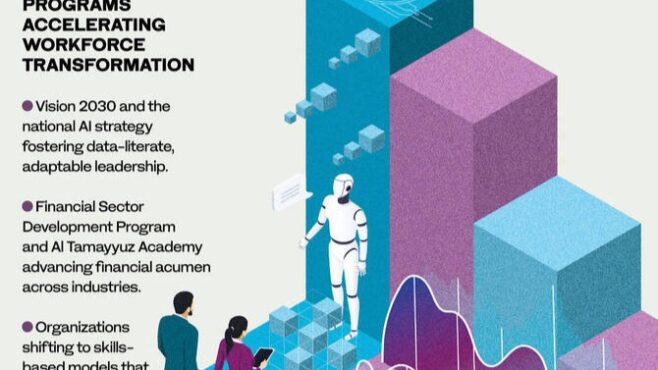
“While AI can democratize access to financial tools, critical judgment and ethical considerations depend on human capabilities,” Tawfiq suggests. The training from Balinca ensures participants utilize AI as an assistant rather than as a replacement. This initiative aligns with national programs aimed at improving financial literacy across various sectors as part of Vision 2030.
Leadership in an Evolving Economy
Jonathan Holmes, Managing Director of Korn Ferry Middle East, adds that Saudi Arabia’s digital evolution is cultivating a new class of leaders—agile, data-savvy, and ready to embrace change. “In contrast to Western views where AI may be viewed skeptically, here, it’s a catalyst for economic growth,” he states.
Characteristics of Future Leaders
Korn Ferry’s research highlights essential traits for AI-ready leadership, including decisiveness, continuous learning, and the ability to foster partnerships amidst uncertainty. Holmes asserts that effective leadership in an AI-centric world revolves around guiding people and leveraging AI as a transformative tool rather than a threat.
Building a Future of Financial Confidence
Integrating Tawfiq’s financial literacy initiatives with Holmes’ vision for leadership demonstrates a shared belief: the Kingdom’s strategic edge lies in its human capital’s analytical and ethical capabilities. Tawfiq concludes, “Financial literacy fosters trust and credibility, transforming individuals from operators into leaders.”
As Saudi Arabia advances toward its Vision 2030 goals, the convergence of technology and human potential promises a robust future, with leaders who are well-equipped to navigate the complexities of the modern economy. The shared vision emphasizes that such knowledge not only enhances individual profiles but is vital for collective economic prosperity.