

Transforming Saudi Arabia’s Workforce: Bridging Digital Fluency and Financial Empowerment
As Saudi Arabia’s Vision 2030 initiative revolutionizes the economy, the Kingdom’s workforce is undergoing a significant transformation. The interplay between digital fluency and financial empowerment is emerging as a vital focus for sustainable growth and innovation.
The Importance of Financial Literacy
Experts emphasize that the Kingdom’s greatest asset is its people, specifically those adept at managing financial and technological challenges. According to Shereen Tawfiq, co-founder and CEO of Balinca, financial literacy is not merely a soft skill but a foundational element for national progress. Her company prioritizes financial education through engaging, game-based simulations, enabling learners to develop essential skills such as financial logic, risk assessment, and strategic decision-making.
Empowering Women Entrepreneurs
Tawfiq highlights the latent potential of Saudi women as pivotal players in entrepreneurship and investment. She asserts that transforming just 10-15% of women-led SMEs into growth-oriented businesses could contribute between $50-70 billion to the GDP in five years, further enhancing job creation and promoting innovation across the Kingdom.
A Revolutionary Educational Approach
Balinca adopts a hands-on approach, allowing participants to engage in interactive business simulations where financial impacts can be observed immediately. Tawfiq argues that behavioral learning, essential for truly understanding finance, requires immersive experiences that AI alone cannot offer. While AI can personalize training, the human element ensures that judgment and ethical reasoning remain paramount.
Shaping Future Leaders with AI
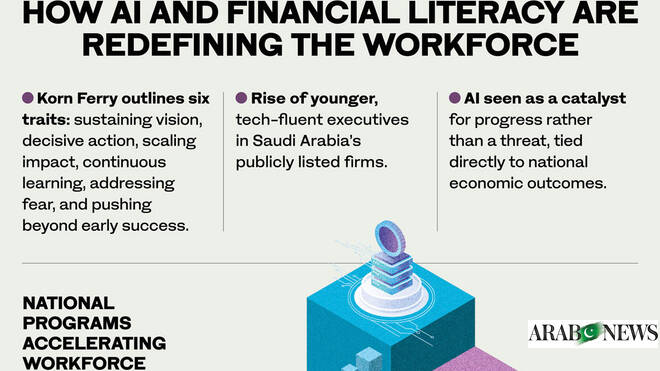
Jonathan Holmes, Managing Director of Korn Ferry Middle East, notes that Saudi Arabia’s digital transformation is cultivating a new generation of leaders who are agile, data-savvy, and ready to embrace disruption. Unlike in many Western markets, where AI is viewed with skepticism, in Saudi Arabia, it is perceived as a catalyst for progress, particularly under the overarching goals of Vision 2030.
Key Characteristics of AI-Ready Leadership
Korn Ferry’s research outlines six characteristics of effective AI-ready leaders: maintaining vision, decisive action, impactful influence, continuous learning, confronting fear, and pushing beyond initial success. Holmes emphasizes that leading in an AI-driven landscape ultimately revolves around inspiring people and fostering partnerships that leverage technology’s strengths.
Flexible Work Models and Cultural Transformation
As the Kingdom embraces competency-based employment models that align talents with project needs rather than rigid roles, flexibility emerges as a cornerstone of modern success. This cultural shift, intertwined with technological advancement, underscores that genuine progress flourishes when inclusion and innovation are prioritized.
In this evolving landscape, Tawfiq pushes for increased dialogue around financial topics among women, fostering confidence and encouraging them to see themselves as economic decision-makers. Together, the visions of leaders like Tawfiq and Holmes set the stage for a workforce transformation that balances inclusivity with data-driven decision-making, ultimately serving as a model for global evolution under Vision 2030.