Financial technology, or fintech, is full of many companies competing for market share. It’s for good reason. According to Fortune Business Insights, the global financial technology market is worth approximately $300 billion today and will reach more than $1.1 trillion by 2032.

The problem for investors is that since no one can reliably tell you which companies will dominate the sector a decade from now, many promising stocks in the sector have languishing prices because Wall Street doesn’t trust them. Conversely, it creates an opportunity for substantial long-term investment returns for those who ultimately support good businesses.

These three companies are trading at incredibly low stock prices, despite their enormous long-term potential and strong business results. Let’s check them.

Digital banking and fintech company SoFi Technologies (NASDAQ:SOFI) continues to produce excellent results quarter after quarter. The company got its start in the student loan business, which apparently helped it develop lasting appeal among young people as they become ordinary citizens with banking needs. SoFi surpassed 8.1 million banking customers in the first quarter, driven by a 44% year-over-year jump.

Customers seem to like SoFi’s “all-in-one app,” which offers financial education, lending products, banking and investing services, and payments all in one place. SoFi’s digital footprint completely eliminates the need for physical bank branches, and the app’s 4.8-star rating from over 340,000 reviews speaks volumes about customer satisfaction. SoFi grows with new users, but can also sell different products and services to customers at no additional cost once users are on the app.

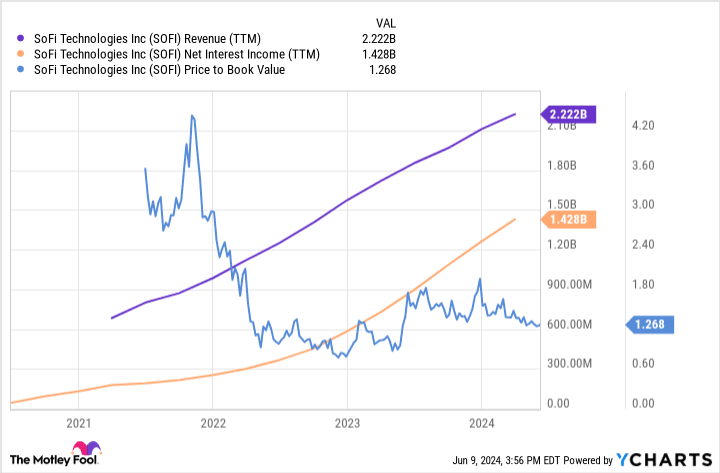
SOFI Earnings Chart (TTM)

SoFi’s earnings (net interest income) began to explode after the company officially received its banking charter in 2022. The stock’s valuation via its price/book value ratio has declined steadily over time. Now, at a more reasonable 26% premium to book value, SoFi could move higher if the company’s growth continues at this breakneck pace.

Buy now, pay later (BNPL) emerged a few years ago as a rival to credit cards, in part because it is a more transparent method of consumer borrowing. Affirm (NASDAQ:AFRM) is one of the leading players in the sector, thanks in particular to partnerships across the retail sector, notably with Amazon, Shopifyand more than 292,000 other merchants. Affirm uses data to individually underwrite each transaction as a loan, which helps Affirm prevent customers from overborrowing. The company charges no late fees, so it’s in Affirm’s best interest for customers to repay their loans quickly.